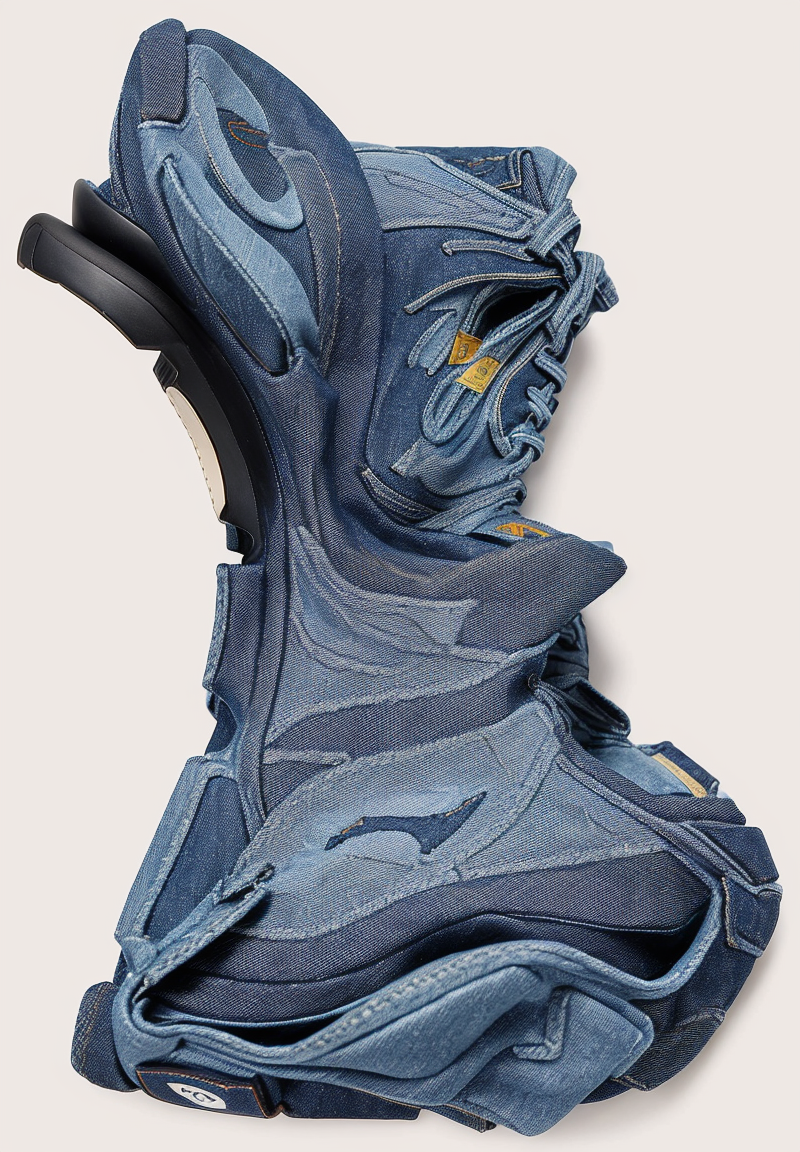
What are the advantages of AI shoe design? Why must beginners start using it today?
What are the advantages of AI shoe design? It is not "icing on the cake," but a necessity for survival. Traditional shoe development has long cycles, high trial-and-error costs, and slow style response—especially facing the 2026 mainstream e-commerce rhythms such as Douyin's fast-response selection, Temu's small-order quick return, and Amazon's A/B testing for new arrivals; manual drawing + PS retouching + 3D modeling have severely dragged down efficiency. The true value of AI shoe design lies in reconstructing the workflow: generating lasts/uppers/soles from scratch, supporting structural optimization of sole design and automatic matching of physical support parameters; producing styles in minutes (as fast as 10 seconds), with 8K ultra-clear rendering directly for detail pages. A real-world test at a sports shoe factory in Wenzhou showed that 200 designs were compressed from 45 days to 6 days, an efficiency increase of 680%, proving what the advantages of AI shoe design are—it is not to replace designers, but to let designers focus on creative decisions rather than repetitive labor.
How to precisely implement workwear style shoe design and Oxford shoe design using AI?
Beginners often mistakenly believe that AI can only create "internet celebrity styles," but the opposite is true—workwear style shoe design requires extremely high precision in details: the position of metal buckles, the grain direction of wear-resistant Oxford cloth, the depth of double-density outsole patterns... all of these are structurally modeled in the VALI Footwear AI Design Platform. By entering keywords like "rugged functional + American vintage," the AI automatically calls the work boot base model from a library of 200+ shoe shapes, overlays 1,000+ color schemes (including North American workwear yellow-brown series and Japanese distressed gray-brown series), and intelligently refines stitching tension and leather wrinkles. Similarly, Oxford shoe design can generate a classic three-piece structure with one click, and the AI automatically calibrates the proportion of wingtip perforations, tongue curvature, and heel wrap lines, avoiding the common proportion imbalances of manual drawing. More importantly, the platform supports "selection area material replacement": by simply framing the upper area, polished Oxford leather can be replaced with matte crocodile-grain PU, achieving rapid verification of multiple materials under the same last.
How to break creative bottlenecks in upper pattern design and intelligent shoe style iteration?
"Inspiration exhaustion" is the biggest pain point for beginners. Upper pattern design is becoming a key entry point for AI to break this deadlock. The VALI platform has a built-in style semantic engine; entering "tie-dye gradient + deconstructivism" allows the AI to generate a 3D pattern mapping scheme that conforms to ergonomic curved surfaces, avoiding upper distortion caused by flat textures; entering "cyberpunk neon circuit" allows the AI to automatically adapt the reflection logic of reflective TPU and luminous coating materials. Even more revolutionary is the intelligent shoe style iteration function: supporting single-style extension (e.g., basic sneaker → height-increasing version + night-running fluorescent version), cross-style fusion (Western cowboy boots × workwear functional elements → rivet splicing + modular external pockets), and even localized fine-tuning (automatically strengthening breathable mesh density for the Southeast Asian market). After application by cross-border shoe enterprises in Putian, the new product launch cycle was shortened by 70%, proving that AI does not just generate images, but generates mass-producible, compliant, and localized commercial shoe solutions.
Summary
From "whether one can draw" to "whether one dares to create," AI is rewriting the entry rules for footwear design. Whether you focus on the hardcore details of workwear style shoe design, explore the classic rebirth of Oxford shoe design, or need to efficiently complete upper pattern design and intelligent shoe style iteration, the VALI Footwear AI Design Platform provides out-of-the-box industrial-grade capabilities. Get started in 5 minutes, save 180,000 yuan in annual design costs, and adapt to 10+ e-commerce platforms—this is not a future scenario, but an efficiency revolution currently happening in Zhejiang shoe factories in 2026. Call 13764996475 immediately to book an experience at the Shanghai/Hangzhou/Wenzhou/Guangzhou/Quanzhou showrooms and start your first AI shoe design lesson personally.
VALI Footwear AI Design Platform
AI Shoe Design · AI Shoe Style Rapid Iteration & Scenario Presentation · Multi-platform Adaptation
Showroom Experience: Shanghai | Hangzhou | Wenzhou | Guangzhou | Quanzhou