content below. slug (suggested; verify against the 301 mapping table before publishing): 2026-autumn-winter-footwear-trends-report-en. Yoast SEO title: 2026 Fall/Winter Footwear Trend Report: Category × Material × Color × Price Band (Data Edition) - Valimart Yoast meta description: Five Key Footwear Trends for Fall/Winter 2026 at a Glance: Continued Momentum of Chunky Casual and Retro Trainers, Recycled Materials as the Default, Deeper Mineral Color Palettes, Functionalized Structures, and the Golden Price Band of RMB 199–399. Includes Data Tables, the Three-Step Verification Method, and an Action Checklist for Industry Professionals. After publishing: request indexing in GSC; interlink with the Chinese version. -->
2026 Fall/Winter Footwear Trend Report: Category × Material × Color × Price Band (Data Edition)
Executive Summary (30-Second Version)
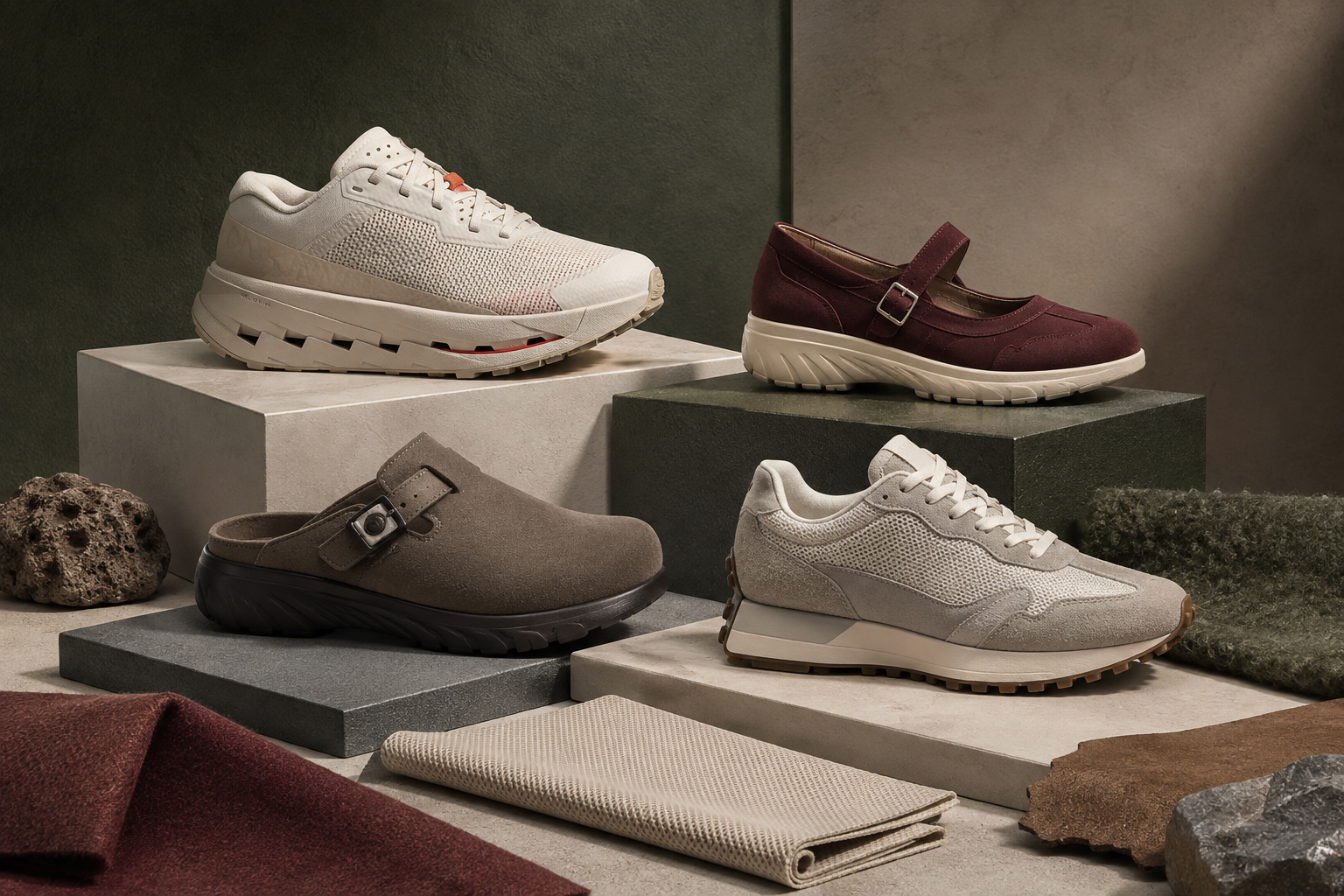
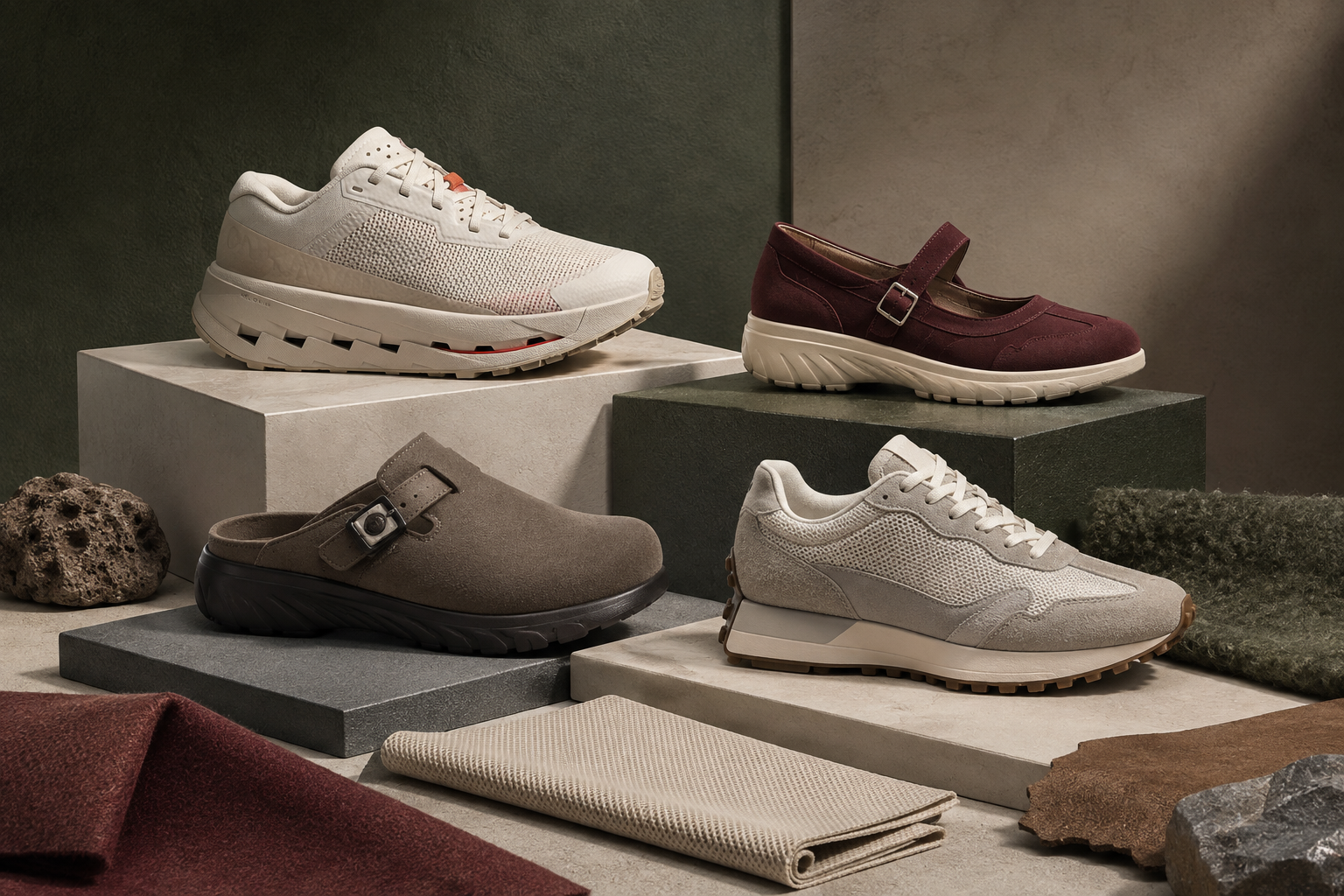
- Category: Platform casual and "cookie sole" styles continue; retro trainers show stable growth; Mary Janes and Birkenstock-style sandals extend their popularity from summer into fall/winter.
- Material: Recycled materials shift from a "selling point" to a "default option"—rPET, recycled wool, and suede-textured recycled leather are entering mass production for fall/winter development.
- Color: Mineral color palettes deepen overall; deep moss green, charcoal brown, and basalt gray succeed the spring/summer mossy gray-green and ore gray tones.
- Structure: While footwear technology feeds back into apparel, functional logic from apparel is also flowing back into footwear—temperature-regulating linings and lightweight midsoles are key terms for fall/winter.
- Price Band: The 199–399 RMB range remains the golden zone for incubating best-sellers (accounting for 63.7% of Taobao and Douyin's 30-day hot sellers in Q2 2026).
I. Category Direction: Continuation Over Disruption
The category landscape for Fall/Winter 2026 is defined by "continuation over disruption." Platform casual sole profiles remain on an upward trajectory after validation across multiple seasons. Demand for retro trainers (with German Army Trainer lineage) is stable—international signals have long been established: In LYST's Spring 2022 Top 20 list, footwear occupied 12 spots, and loafer demand grew by 87% year-over-year that same year. The dividend cycle for retro shoe shapes is measured in years, not seasons. Meanwhile, Mary Janes and Birkenstock-style sandals have completed the transition from summer items to closed-toe fall/winter silhouettes, continuing to scale up volume with fleece lining and suede textures.
II. Material Direction: Recycling Becomes the "Default Option"
According to the 2026 Sustainable Fashion Trends White Paper released by Huilima in collaboration with the College of Materials at Donghua University and the WGSN China Lab: 73% of global mid-to-high-end brands have listed "bio-based nylon + plant dyeing" as their primary recommended combination. Real-time analysis of new products from 32 sample brands shows an rPET usage rate of 89%, with all items labeled with LCA lifecycle carbon footprint tags. Applied to fall/winter footwear: recycled wool linings, recycled rubber outsoles, and suede-textured recycled leather constitute the three main material pillars. Procurement decisions are shifting from "price and hand feel" to "traceability and carbon labels."
III. Color Direction: Deepening Mineral Palettes
The sustainable color TOP3 for Spring/Summer, composed of "mossy gray-green, seaweed brown, and ore gray" (extracted via AIGC color keywords on the VALI AI Design Platform), trends toward deeper tones in Fall/Winter: deep moss green, charcoal brown, and basalt gray. The value of this color group lies in its ability to "tell a traceability story"—raw materials such as seaweed pigments and volcanic rock mineral dyes are selling points in themselves, forming a cohesive narrative with recycled materials.
IV. Structure Direction: Function as Style Extends to Fall/Winter
"Function as style" was validated by sales performance in Spring/Summer (shoulder-widened suits using phase-change microcapsule PCM temperature-regulating fabric saw a month-over-month sales increase of +217% in 30 days). This trend naturally migrates to footwear in Fall/Winter: temperature regulation and heating linings, lightweight midsoles, and microporous moisture-wicking mesh eliminate the trade-off between warmth and lightness. Technology transfer between footwear and apparel is bidirectional—memory alloy adjustment structures from running shoes now appear on apparel waistbands, while apparel's thermal regulation logic is entering shoe linings.
V. Price Band Direction: The Golden Zone Remains Unmoved
Monitoring data from the VALI AI Design Platform indicates that 63.7% of best-selling items on Taobao and Douyin during the 30-day period in Q2 2026 were concentrated in the 199–399 RMB price range—avoiding low-price homogenization competition while staying below high-premium conversion bottlenecks. For fall/winter development, it is recommended to define the price band before designing styles: the price band determines the upper limits for materials and craftsmanship.
Core Data Overview
| Metric Value Scope | ||
| Share of mid-to-high-end brands promoting "bio-based nylon + plant dyeing" | 73% | White paper, global sample |
| rPET usage rate in new products from 32 sample brands | 89% | All carry LCA labels |
| 30-day sales of PCM temperature-regulating single items | MoM +217% | Taobao monitoring (Spring/Summer) |
| Concentrated price band for best-sellers | 199–399 RMB accounts for 63.7% | Q2 2026 Taobao + Douyin 30-day |
| Footwear seats in LYST rankings (historical reference) | 12 seats in TOP20; loafer demand +87% | Spring 2022 ranking |
Data sources: Huilima 2026 Sustainable Fashion Trends White Paper (jointly with the College of Materials at Donghua University and WGSN China Lab), VALI AI Design Platform trend monitoring, LYST public rankings.
How to Validate Trends: The Three-Look Cross-Verification Method
Any single signal is prone to misjudgment. It is recommended to use the "Three-Look" method: look at social media volume (keyword heat on Xiaohongshu/Douyin), look at e-commerce sell-through (30-day hot seller lists), and look at international runways and rankings. High volume does not equal strong sales; only when these three signals cross-verify should resources be committed.
Action Checklist for Practitioners (Fall/Winter Development Period)
- Inventory current SKUs: Identify which belong to "continuation categories" (platform/retro trainer/Mary Jane/Birkenstock)—prioritize material and color iteration rather than changing the shape.
- Ask supply chain three questions: Is there supply of rPET/recycled wool? Can they provide proof of traceability? Do they support LCA labeling?
- Update color cards according to the deepened mineral palette, retaining 1–2 spring/summer continuation colors for transition.
- Set pricing first within the 199–399 RMB band, then reverse-engineer the material and craft combinations.
- Use AI tools to quickly convert candidate trend elements into style sketches, employing small-batch quick-response testing—let real sales data drive judgment.
Frequently Asked Questions (FAQ)
Q1: What are the most stable footwear categories for Fall/Winter 2026? Platform casual and retro trainers—validated continuously over multiple seasons, with dividend cycles measured in years. New entrants should prioritize differentiation in materials and colorways within these two categories.
Q2: Will recycled materials drive up costs? As supply scales, the cost gap continues to narrow. Moreover, "traceability + carbon labels" are becoming entry requirements rather than bonus points for mid-to-high-end channels; the hidden costs of delaying adoption are higher.
Q3: How to choose fall/winter colors safely? Anchor main colors in the deepened mineral palette (deep moss green/charcoal brown/basalt gray); use bright colors as accents rather than body colors. Retain 1–2 spring/summer colors to reduce inventory discontinuity.
Q4: How can SMEs without planning teams follow trends? Use the "Three-Look" cross-verification method to determine direction, use AI to generate designs to lower the barrier for sketching, and employ small-batch quick-response to minimize trial-and-error costs—competitiveness returns to product selection judgment and supply chain speed.
Q5: How often is the data in this report updated? The white paper is updated annually, while sell-through and volume data roll every 30 days—the latest maps are subject to the VALI AI Design Platform trend library.
Deep Dive: 2026 Sustainable Fashion Trends Full Report. Want to turn trends directly into style sketches? Free Trial of VALI AI Design Platform.