Key takeaways
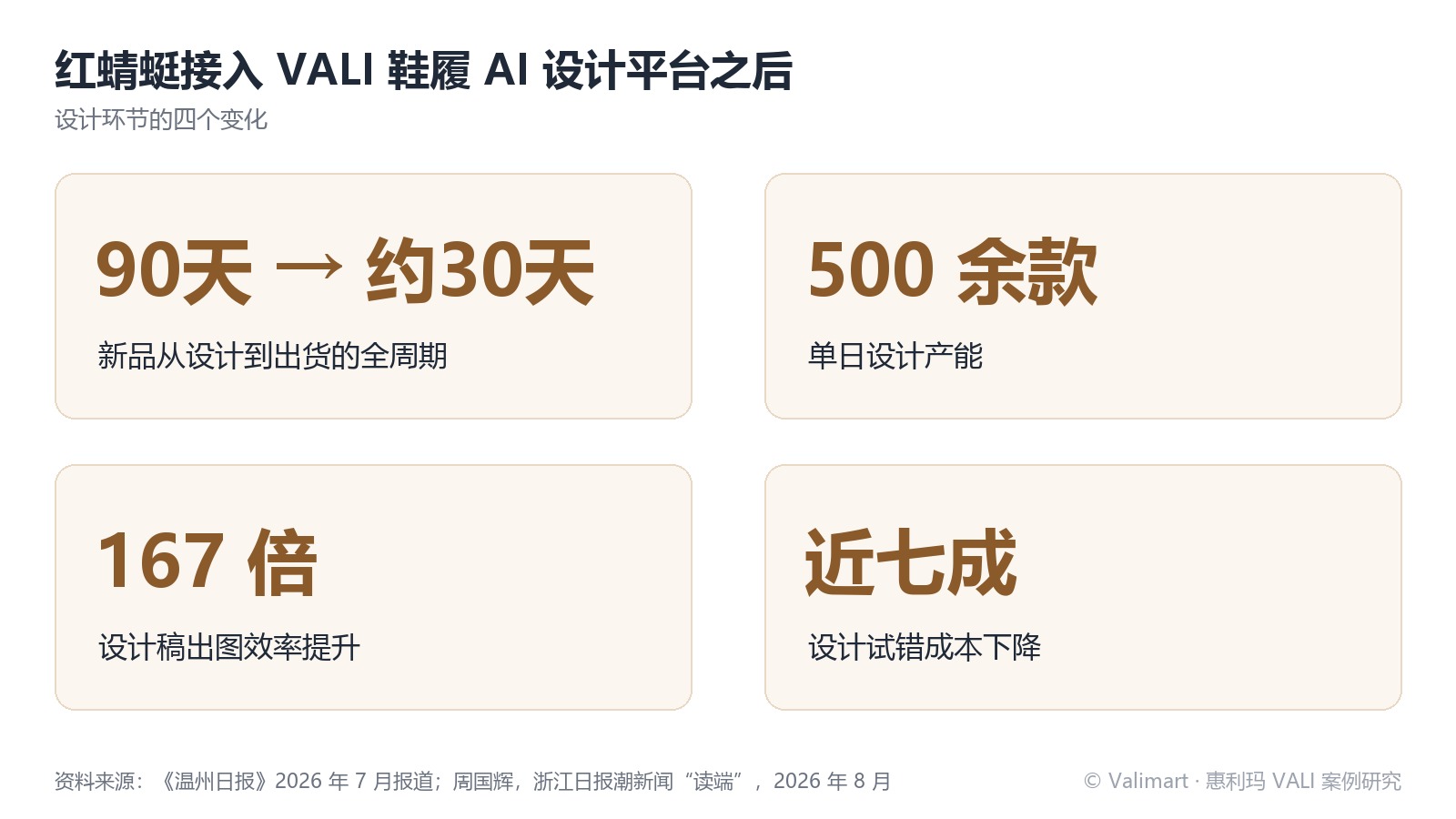
- The design cycle shrank to about a third. According to a July 2026 report in Wenzhou Daily, Red Dragonfly (Hongqingting) was one of the first brands to use the VALI AI footwear design platform in depth. After adopting it, the brand's design output reached 500-plus styles a day, design drawing output became 167 times more efficient, and the full cycle from design to shipment fell from the traditional 90 days to about 30 days.
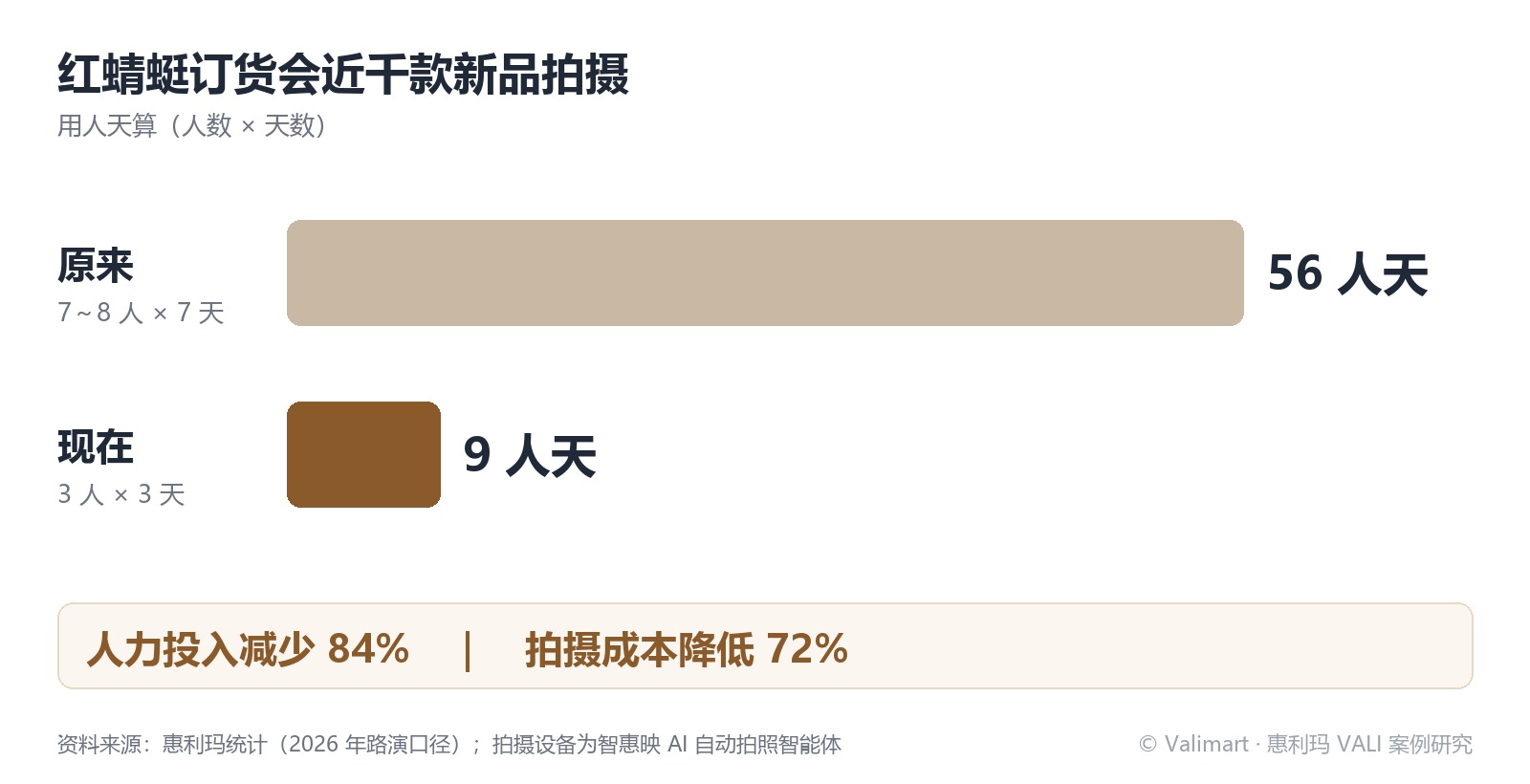
- Order-fair photography fell from 56 to 9 person-days. For nearly 1000 new styles at a Red Dragonfly order fair, shooting used to take 7 to 8 people 7 days. With the VALI AI auto-photography station, 3 people finished in 3 days: labour input fell by 84% and shooting cost by 72% (Valimart figures).
- Upstream suppliers use the same platform. According to a front-page report in Zhejiang Daily on 2026-06-12, sole makers used to produce large numbers of physical samples for shoe brands to choose from, with a hit rate below 30%. Now AI can design 500 soles a day, each shown in 3D on matching shoe styles, and the cycle from design to shipment is 20 days shorter.
- Industry data is what makes it workable. The reports say the platform is built on nearly 200 million data labels plus 800000 patterns, 100000 lasts and other industry records, so its designs can be matched to real materials and factories rather than staying as renderings.
- Smaller shoe factories can go step by step. An October 2026 report by Yongjia Release describes a tiered approach: leading companies connect R&D, production, supply and sales end to end, while smaller factories can start with the AI design module alone or with e-commerce photography.
Author: Valimart VALI Case Studies | Published: 2026-11 | Sources: Zhejiang Daily front-page report (2026-06-12), Wenzhou Daily report (July 2026), article by Zhou Guohui (Zhejiang Daily Chao News "Reading" column, August 2026), Yongjia Release report (2026-10) and Valimart 2026 roadshow data. Every figure in the article is attributed.
1. Why Red Dragonfly did this
Red Dragonfly is a leading shoe company in Wenzhou, China's shoe-making hub. According to the Zhejiang Daily front-page report of 2026-06-12, shoe companies faced three problems: R&D lacked technology, production lacked data and sales lacked channels. Red Dragonfly realised that without a breakthrough in new technology it would soon hit the industry's ceiling.
Its answer was to incubate the Valimart footwear and leather industrial internet platform. Using data from Red Dragonfly itself and companies along its supply chain, nearly 200 million data labels on materials, colours and more were used to train the VALI AI vertical model for footwear and apparel. The platform built 29 AI modules, such as colour and material matching, style fusion and sole generation, and focused on three high-frequency scenarios: design, product selection and photography.
Zhou Guohui, vice chairman of the 12th Zhejiang Provincial Committee of the CPPCC, commented on the case in the Zhejiang Daily Chao News "Reading" column: the industry data accumulated by traditional industries is exactly the "high-quality industry dataset" that AI training needs most, and the models that really solve industry problems are vertical ones built on deep industry knowledge.
2. Design: new-product cycle from 90 days to about 30
According to the July 2026 Wenzhou Daily report, after adopting the platform Red Dragonfly's designers first use its global trend data and regional consumer preference data to set a creative direction, then draw on patterns and colour materials while AI helps create styles and colourways. The report gives the following changes:
| Metric | Before | After | Source |
|---|---|---|---|
| Full cycle from design to shipment | About 90 days | About 30 days | Wenzhou Daily, July 2026 |
| Daily design output | — | 500-plus styles | Wenzhou Daily, July 2026 |
| Design drawing efficiency | — | 167 times higher | Wenzhou Daily, July 2026; Zhou Guohui's article |
| Design trial-and-error cost | — | Down by nearly 70% | Wenzhou Daily, July 2026 (Zhou Guohui's article: "cost reduced by nearly 70%") |
Behind these figures is a body of industry data. The same report says the platform holds more than 34000000 images of styles, fabrics and colours with nearly 200 million data labels, plus 1000000 sets of raw-material and construction data, 800000 patterns, 100000 lasts, 3000000 foot-scan images, more than 10000 design styles and more than 2000 standard colour codes. The patterns and colour materials designers use come from here, so the styles they produce match patterns and materials that can actually be made.
3. Photography: nearly 1000 styles shot by 3 people in 3 days
Once new styles are designed, the order fair and online launches all need product images, and this step used to take a lot of people. For nearly 1000 new styles at a Red Dragonfly order fair, shooting used to take 7 to 8 people 7 days. With the VALI AI auto-photography station, 3 people finished in 3 days.
| Item | Before | Now | Change |
|---|---|---|---|
| People | 7 to 8 | 3 | — |
| Days | 7 | 3 | — |
| Labour input (person-days) | 56 | 9 | Down 84% |
| Shooting cost | — | — | Down 72% |
Source: Valimart figures (2026 roadshow). Person-days are people multiplied by days.
The Wenzhou Daily report also describes this step: shooting and cutting out a single product takes about 30 seconds, and multi-angle images, scene images and standard detail pages are ready in three to five minutes and can be pushed to e-commerce and live-streaming platforms.
4. Can AI-designed shoes go straight into production?
This is what shoe factories care about most. The October 2026 Yongjia Release report quotes the Valimart team: "General-purpose large models understand aesthetics, but not shoemaking." A shoe involves leather grain, last curvature, sole construction and stitching; if AI cannot read these, the factory cannot make what it draws, and the idea is wasted.
The workflow the report describes is: a designer enters trend keywords on the VALI platform and AI outputs several footwear designs; once a design is confirmed, the supply-chain system matches leather and trims and sends the job to partner factories; after production, the VALI photography station shoots the product images and pushes them to e-commerce platforms.
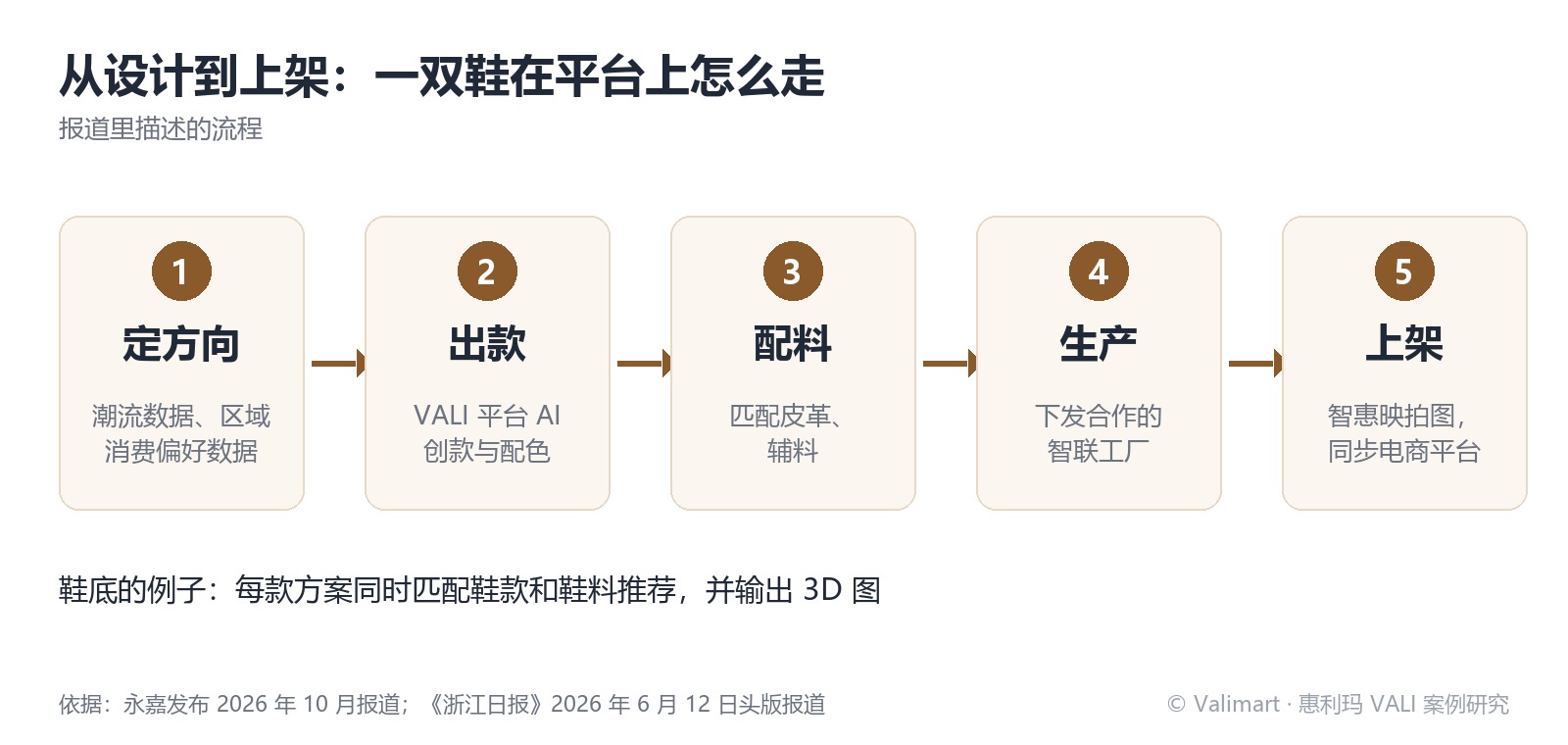
Soles are a concrete example. According to the Zhejiang Daily report, the sole maker Shengli Shoe Materials used to produce large numbers of physical samples for shoe brands to choose from, with a hit rate below 30%, high costs and a lot of waste. Now AI can design 500 soles a day, each shown in 3D on matching shoe styles, with shoe and material recommendations included, and the cycle from design to shipment is 20 days shorter.
| Step | Old way | With the platform |
|---|---|---|
| Design | Produce many physical samples for brands to choose from; hit rate below 30% | AI can design 500 soles a day, each shown in 3D on matching shoe styles |
| Materials | Matched separately by experience | Each design comes with shoe and material recommendations |
| Cycle | — | Design to shipment 20 days shorter |
Source: Zhejiang Daily front-page report, 2026-06-12.
So the answer is: a design has to match patterns, lasts and materials before it can go into production. The approach in the reports is AI proposes, the supply chain matches materials and the factory produces, not opening a mould straight from a rendering.
5. What smaller shoe companies can take from this
Red Dragonfly is a leading company and works across the whole chain. The Yongjia Release report also describes a tiered approach: leading companies can connect R&D, production, supply and sales end to end, while smaller factories can choose the AI design module as needed, or bring in the VALI photography station for e-commerce shooting, cutting cost at one point first and expanding step by step. As of October 2026 the platform had more than 50000 registered designers, links to more than 80 smart factories and more than 1000 paying business customers, and the practice was selected as a typical case of industrial data-element application by China's Ministry of Industry and Information Technology.
- Start with the slowest step: if launches stall at design, start with the design module; if they stall at photography, fix shooting first. There is no need to do everything at once.
- Keep the numbers: like Red Dragonfly's order fair, count person-days (people multiplied by days) before and after going live, so you know what you saved.
- Match patterns and materials when choosing designs: check lasts, patterns and materials while picking a design, to cut sample rework.
- Test in small batches first: make a small run of a new style, then reorder based on market feedback.
- Build up your own data: the more clearly you organise your patterns, materials and sales data, the closer AI's designs get to what you can make and sell.
FAQ
How do shoe factories use AI to design styles?
Take Red Dragonfly: designers first set a direction using the platform's global trend data and regional consumer preference data, then draw on patterns and colour materials while AI helps create styles and colourways. According to the July 2026 Wenzhou Daily report, design output reached 500-plus styles a day after adoption, and the cycle from design to shipment fell from about 90 days to about 30.
Can AI-designed shoes go straight into production?
It depends on whether the design matches patterns, lasts and materials. In the reported workflow, after AI proposes a design the supply-chain system matches leather and trims and sends it to partner factories; in the sole example, each design comes with shoe and material recommendations, and the cycle from design to shipment is 20 days shorter.
What AI tools does Red Dragonfly use?
The VALI AI footwear design platform for design and the VALI AI auto-photography station for shooting, both from Valimart, which Red Dragonfly incubated. Shooting nearly 1000 new styles for an order fair went from 7 to 8 people over 7 days to 3 people over 3 days, cutting labour input by 84% and shooting cost by 72%.
Original sources (in Chinese, full reposts on Valimart's WeChat account): Zhejiang Daily front-page report, Wenzhou Daily report, Zhou Guohui's article, Yongjia Release report.
Want to see what AI can design for your range? Try the VALI AI footwear design platform: enter a direction and get design images.
About Valimart
Valimart is a digital services platform for the footwear and leather industry, incubated by Red Dragonfly. The VALI AI footwear design platform handles style design and colour and material matching; the VALI AI auto-photography station shoots, retouches and builds product images and detail pages for e-commerce.